
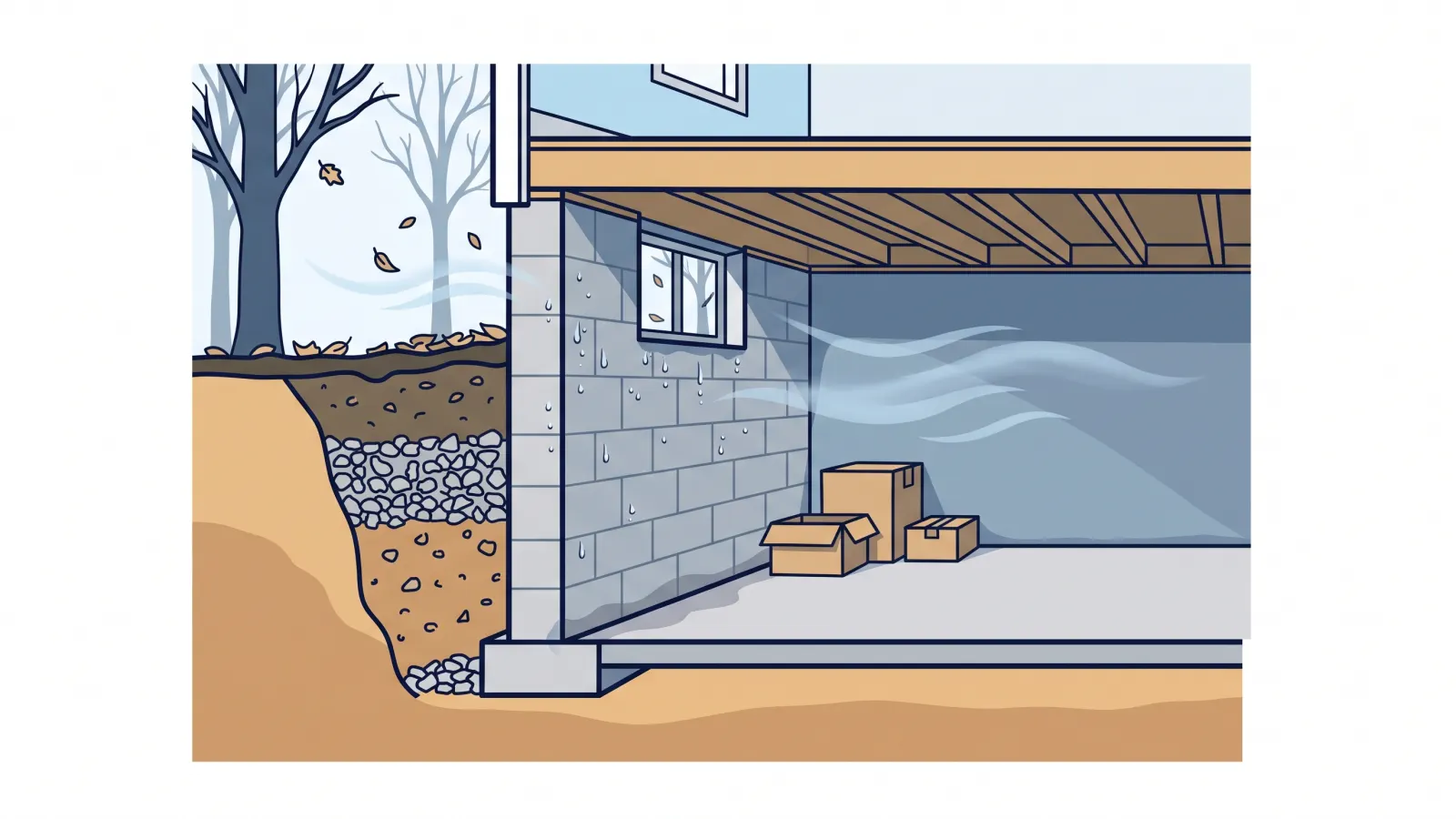
A musty basement smell means moisture. In fall and winter it usually comes from one of two places: humid air meeting cold basement walls and turning into condensation, or water getting in through the walls or floor. A musty smell with no visible water usually means humidity and evaporation rather than an active leak. The fix depends on which one you have, and a simple test tells you.
In short: the smell is damp material, so find the moisture. Tape plastic to the wall for two days. Wet on the room side means humid air; wet underneath means water coming through the wall. The US EPA advises keeping indoor humidity below 60 percent. If water is getting in, start with downspouts and grade outside.
Written and reviewed by Swift Dry Construction, Michigan licensed residential builder #262400278, based in Farmington Hills.
What a musty basement smell means
The smell itself comes from damp materials: concrete and block that hold moisture, cardboard boxes, wood framing, carpet and anything stored against a wall. When those stay damp, mold and mildew grow on them, and that is what you smell. Mold here is a sign of moisture, not the problem itself. The US EPA's guide to mold, moisture and your home says it in one line: "The key to mold control is moisture control." Dry the space out and deal with the source, and the smell goes with it.
So the useful question is not "what is the smell" but "where is the moisture coming from". In a Michigan basement there are three usual answers:
- Condensation. Warm, humid air touches a cold wall, floor or pipe and leaves water on it.
- Water moving through the masonry. Wet soil outside pushes moisture through concrete or block. It evaporates from the inside face, often without ever forming a puddle.
- An active leak. Water comes in through a crack, the wall-floor joint or the floor after rain or snowmelt.
Why the smell gets worse once the house is closed up
If the smell showed up in fall, just after the windows were shut for the season, a few things changed at once.
The basement walls cool down. The soil outside loses its summer warmth, so the walls and floor are colder than the air in the room. Any humid air that reaches them leaves moisture behind.
The air stops moving. With the windows closed and the house sealed against the cold, there is less fresh air to carry moisture and odour out. What was a faint smell in August becomes obvious in November.
The fall rains soak the soil. Clay soil is common across Metro Detroit and it drains slowly, so after a wet fall the ground against the foundation stays saturated for longer. More water in the soil means more moisture moving through the wall.
Then winter adds the thaw. Each melt puts a lot of water into the ground at once, and a wall that only smelled damp in fall can start to show wet patches.
Humidity or an active leak? How to tell
The diagram below walks through the checks in order.
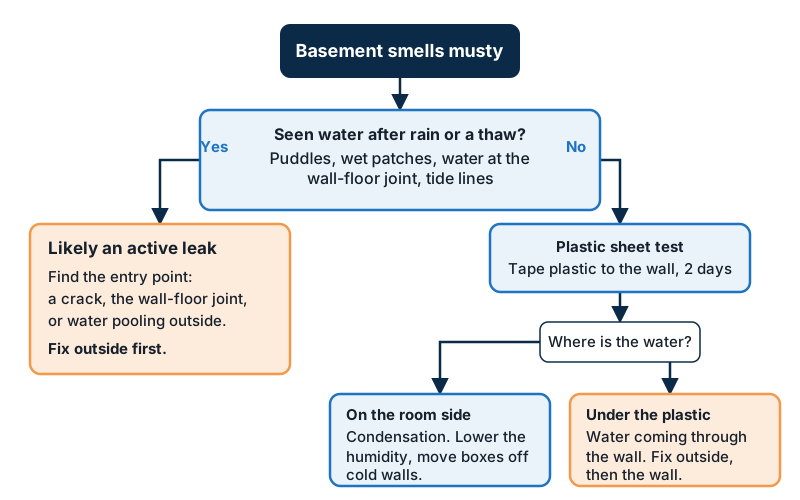
- Look for water after rain or a thaw. Check the wall-floor joint, the base of each wall, under stairs and behind stored things. Water in one corner after a storm points to a downspout or grade problem outside.
- Look for staining and residue. Tide lines on the wall, rust on metal shelving legs, or efflorescence, the white chalky residue on concrete or block. Efflorescence means water has been moving through the masonry and leaving minerals behind, even if you never saw it wet.
- Do the plastic sheet test. Tape a square of clear plastic, about the size of a sheet of paper, tight to the wall on all four sides. Leave it for two days. If moisture forms on the room side, the air is too humid and the wall is cold: that is condensation. If moisture forms underneath, against the wall, water is coming through the wall from outside.
- Measure the humidity. A hygrometer, a small humidity meter sold at hardware stores, shows the relative humidity. The EPA recommends keeping indoor humidity below 60 percent, ideally between 30 and 50 percent. Take readings at different times of day and after rain. A basement that stays above that range, or reads much higher than the rest of the house, has a moisture source worth finding.
Keep notes and photos. They help whoever looks at the basement next.
| What you find | What it usually means | Where the fix starts |
|---|---|---|
| Plastic wet on the room side, no puddles | Condensation from humid air | Lower the humidity, cover cold surfaces |
| Plastic wet underneath, efflorescence | Water moving through the wall | Outside drainage, then the wall |
| Puddles or wet patches after rain or a thaw | An active leak | Find the entry point: crack, joint or grade |
What to do if it is condensation
If the test points to humid air, the work is about lowering humidity and warming or covering the cold surfaces. The first and fourth steps are on the EPA's list:
- Vent the dryer to the outside, not into the basement, and run the bathroom fan when showering.
- Do not dry laundry on lines in the basement.
- Move cardboard boxes off the floor and away from the walls. Plastic bins on shelves do not soak up moisture the way cardboard does.
- Cover cold water pipes with insulation. The EPA lists it among its ways to prevent condensation.
- A portable dehumidifier can bring the humidity down. Empty it or run it to a drain, check the hygrometer, and watch whether the smell goes.
If the humidity stays high even with those steps, look again at the walls. Condensation and water moving through the masonry often happen together, and the wall is still the source.
What to do if water is coming in
If the plastic is wet underneath, or you have seen water after rain or snowmelt, the fix starts outside the basement.
Walk around the house. Look for downspouts that empty at the wall, ground that slopes toward the house, and low spots where water sits. The Department of Energy's Building America guidance on grading around a foundation calls for sloping soil away from the house "at least 0.5 inch per foot for 10 feet", with swales or drains where there is not room for that. A yard that is flat or tipped toward the wall is worth fixing first. These are often the least expensive fixes. Our page on buried gutter and downspout extensions explains how roof water gets carried out past the backfill.
If the outside is in order and water still gets in, the entry point is in the wall or floor. A wet basement is not one problem with one fix, as our basement waterproofing page explains. Water can come through a crack, the joint where the wall meets the floor, the hollow cores of a block wall, or porous concrete when the ground is saturated. Each one has its own repair. Sealing the wrong surface just moves the water a few feet.
A musty smell can also come from under the house rather than the basement. If part of the house sits over a crawl space, check that too. Air from a crawl space rises into the rooms above it, which is covered on the crawl space encapsulation service page.
A note for Ann Arbor homeowners
Ann Arbor has a wide spread of housing, from older houses near downtown and the university to newer subdivisions toward the edges of the city. The Ann Arbor service-area page explains why that matters. Older block and stone foundations tend to let water in at the base and through the mortar, while newer poured walls tend to leak at vertical shrinkage cracks once the ground stays wet. Some older Ann Arbor houses also have crawl spaces under additions, which can be the real source of a musty smell upstairs.
Musty basement questions
Is a musty smell in the basement always mold?
No. It is usually a sign that something is staying damp long enough for mold or mildew to grow on it, often cardboard, wood or carpet. Find and stop the moisture first. The EPA advises drying wet materials within 24 to 48 hours, because in most cases mold will not grow if they dry in that time.
What humidity should a basement be?
The EPA's guidance for homes is below 60 percent relative humidity, ideally between 30 and 50 percent. A hygrometer tells you where yours sits.
Will a dehumidifier get rid of the smell?
It can if the source is humid air. If water is coming through the wall, a dehumidifier removes some of the moisture after it is already inside, but it does not stop the water. The plastic sheet test tells you which case you are in.
Why does the smell come back every fall?
Because the conditions come back every fall: colder walls, closed windows and wetter soil. If the smell returns each year, the moisture source has not changed.
Get your free basement inspection
If the plastic test came back wet, you have seen water after rain, or the smell is still there after you have brought the humidity down, book a free inspection. Call 248-635-3767 or request a visit online. We will check the basement and the ground around the house, tell you whether it is humidity or water getting in, and give you a written quote if it needs work.
Sources
- US Environmental Protection Agency, A Brief Guide to Mold, Moisture and Your Home: moisture control, the 24 to 48 hour drying window, humidity below 60 percent (ideally 30 to 50), venting dryers outside, insulating cold water pipes.
- US Department of Energy, Building America Solution Center, Final Grade Slopes Away from Foundation: slope soil away from the house at least 0.5 inch per foot for 10 feet; swales or drains where setbacks are tighter.
Want someone to look at yours?
Free inspection, written quote, no obligation. Call 248-635-3767 or request a visit online.
- 4.9 on Google (46 reviews)
- Licensed MI builder #262400278
- Free inspection, written price first
- Free 6-month check-up after every job
- Based in Farmington Hills