
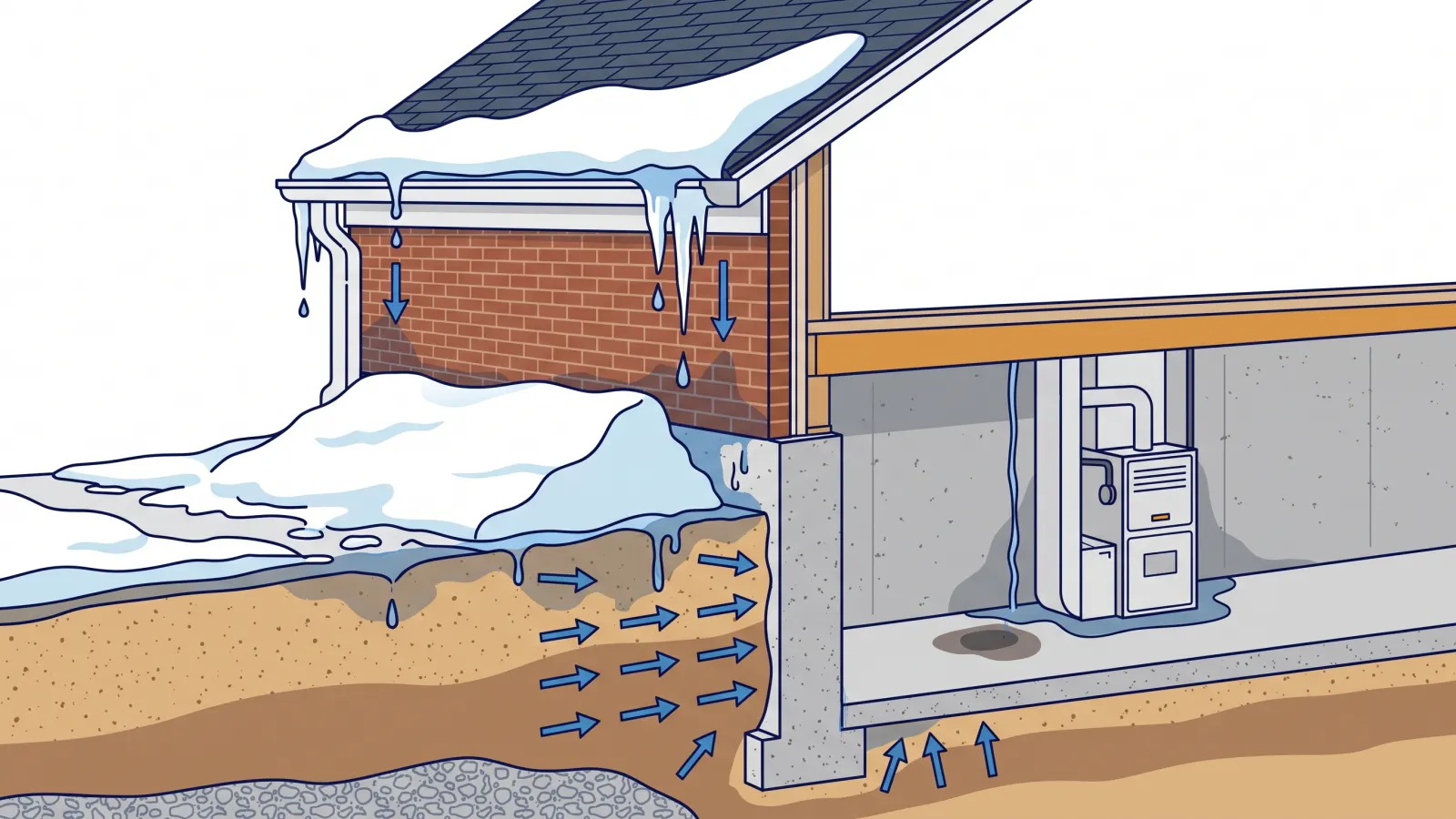
Water gets into basements during a thaw because a lot of snowmelt reaches the soil beside the foundation at once. The ground further down is often still frozen or already soaked, so the water has nowhere to drain. It presses against the wall and up under the floor, and comes in at the weak points: cracks in the wall, the joint where the wall meets the floor, and cracks in the slab. The fix depends on which of those it is and where the water comes from outside, which is why the answer starts with finding the source.
Why does water come in during a thaw and not all winter?
Through most of a Michigan winter, water sits on top of the ground as snow and ice. When it melts, it all arrives together. Snow piled against the house from shovelling or sliding off the roof melts right beside the foundation.
Clay soil is the other half of it. Clay is common across Metro Detroit, and it drains slowly. When the thaw comes, the soil near the surface fills with water faster than it can drain away, and frozen ground a little deeper can stop it soaking down. So the water spreads sideways, toward the backfill around the basement, which is looser and takes it in easily.
Add a downspout that empties at the wall or a yard that slopes toward the house, and one corner of the basement can get far more water than the rest.
Hydrostatic pressure, in plain words
When the soil around a basement is saturated, the water in it pushes on anything in its way. That push is called hydrostatic pressure. It acts sideways on the walls and upward on the floor slab, and it grows the deeper the water sits.
Concrete and block are not waterproof on their own. Under that pressure, water moves through any opening it can find. That is why a basement that stays dry through summer storms can take on water in a thaw: the soil stays saturated for longer, so the pressure lasts longer.
The three usual ways in
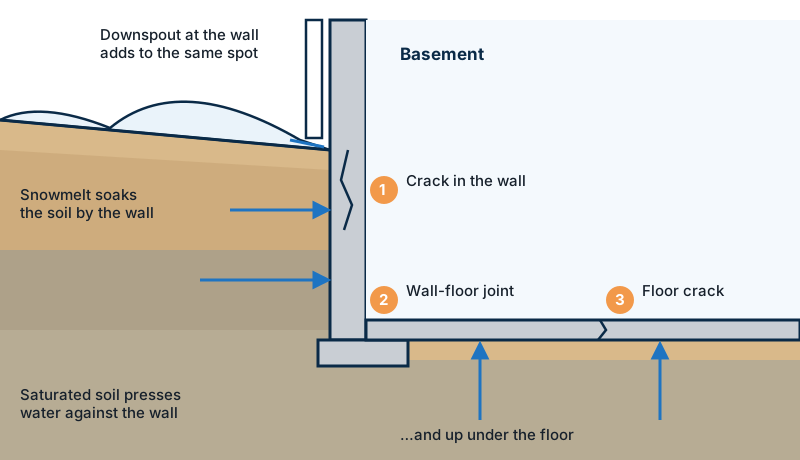
- Cracks in the wall. Water comes through the crack itself, often leaving a damp streak or white residue below it.
- The wall-floor joint. The wall and the floor are poured separately, so there is a seam where they meet. Water under pressure comes up through that seam, and a damp line along the base of the wall is a typical sign of it. In block walls, water that fills the hollow cores can also come out at the base.
- Cracks in the floor slab. Water pushed up from below finds its way through cracks in the floor.
Where you see the water tells you a lot. Water in one corner after a storm usually points to a downspout or grade problem outside that corner. A damp line along a whole wall usually points to saturated soil along that side. Water coming up through the middle of the floor points to pressure under the slab.
Why does my basement smell musty?
A musty smell with no visible water usually means humidity and evaporation rather than an active leak. Moisture from the soil moves through the walls and floor, evaporates into the basement air, and damp air in a closed-up basement smells musty. It can also come from a slow leak you have not seen yet, behind stored boxes or a finished wall.
A musty smell is worth tracking down because it tells you moisture is getting in somewhere. Check behind anything stored against the walls, look at the base of finished walls, and feel carpet at the edges. If you find damp spots, they will usually be near one of the three entry points above.
Cracks in the basement floor: when to worry
Thin cracks in a basement floor are common. Concrete shrinks as it cures, and a slab often has a few hairline cracks that never change. Those are usually not a structural concern.
Look more closely when:
- Water comes up through the crack during rain or a thaw
- One side of the crack is higher than the other
- The crack is getting wider or longer
- The floor has heaved or sunk near the crack
Water through a floor crack means there is water pressure under the slab. The crack is where it shows up, but the real job is dealing with the water underneath, which usually means a drain and a sump pump, not just sealing the crack.
Seepage or sewer backup?
In heavy storms, water can also come up through a floor drain. That is a sewer backup, not seepage. Older combined sewers carry storm water and sewage in the same pipes, so a very heavy storm can push water back into basements through the drain. The fix for that is a plumbing one, usually a backwater valve fitted by a licensed plumber.
Seepage comes through the walls, cracks or the wall-floor joint, and that is the work we do. If you are not sure which one you had, tell us where the water appeared and we will tell you honestly whether it is a job for us. Our Detroit page has more on how older Detroit basements tend to take on water.
What to fix before winter
Several of the causes above can be dealt with before the snow comes:
- Move downspout water away. A downspout that empties at the wall puts roof water exactly where you do not want it.
- Check the grade. Ground should slope away from the house on every side. Settled soil by the foundation is common.
- Test the sump pump if you have one, and make sure its discharge line runs away from the house.
- Plan where the snow goes. When you shovel, pile snow away from the foundation, not against it.
- Mark any damp spots you already know about, so you can compare after the first thaw.
What the fix usually is
A wet basement is not one problem with one fix. Sometimes the outside work above is enough. When water is coming through a crack, the crack is the job. When water is coming in at the wall-floor joint along a wall, the usual answer is an interior drain along the footing that carries water to a sump pump. When the wall needs sealing from the outside, that is exterior waterproofing.
We inspect inside and out, find where the water enters and recommend the smallest fix that solves it. Read more on our basement waterproofing page.
Book a free basement inspection
If your basement took on water in last year's thaw, or you have a damp line or a musty smell now, book a free inspection before winter. Call 248-635-3767 or request a visit online. We will find where the water gets in and give you a written quote before any work starts.
Want someone to look at yours?
Free inspection, written quote, no obligation. Call 248-635-3767 or request a visit online.
- 4.9 on Google (46 reviews)
- Licensed MI builder #262400278
- Free inspection, written price first
- Free 6-month check-up after every job
- Based in Farmington Hills