
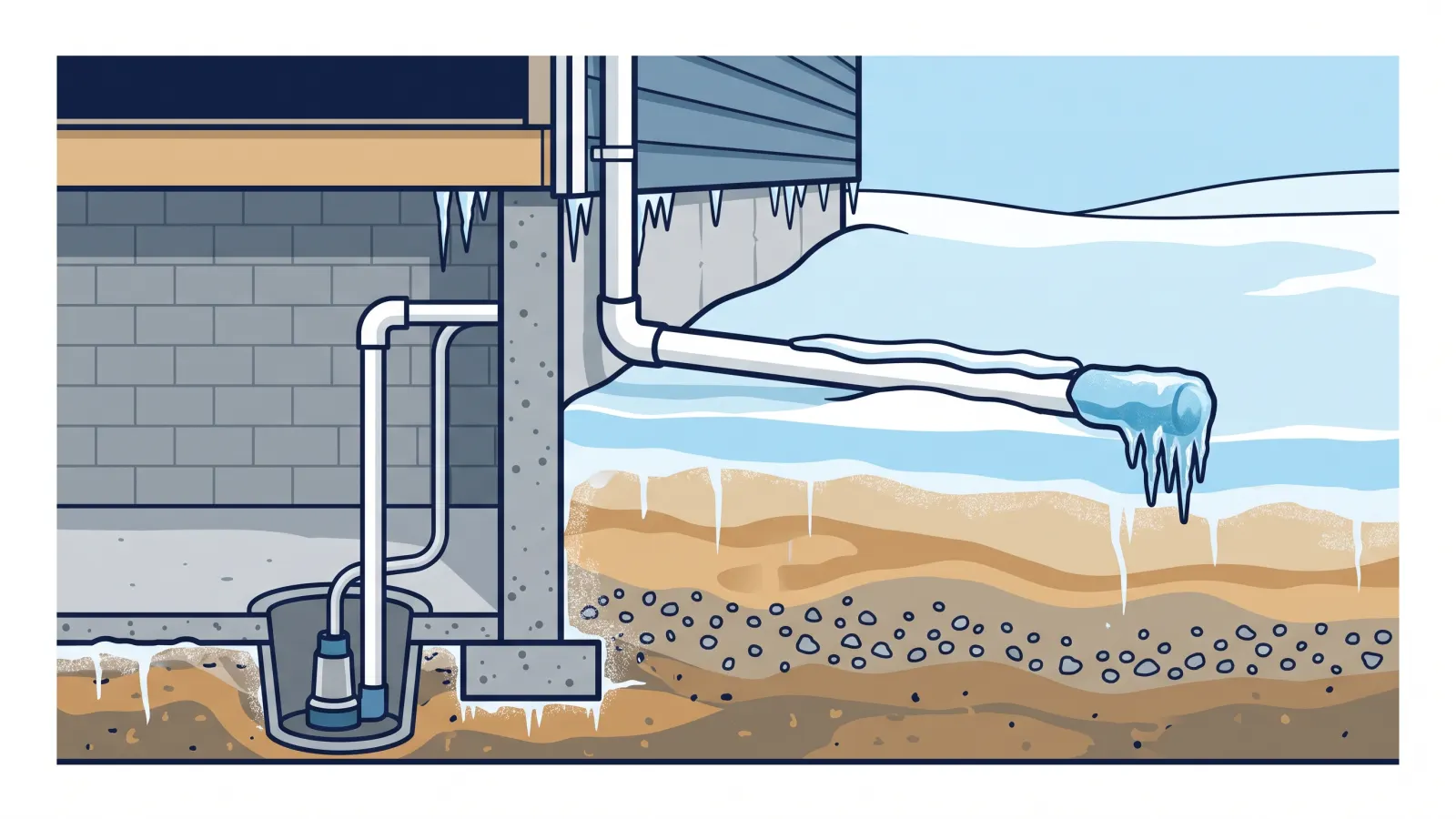
A sump pump discharge pipe outside the house freezes when water sits in it in freezing weather. That happens when the pipe has a low spot or no slope to drain. It also happens when the outlet ends in snow or in a hollow where ice builds up, or when a long run of pipe lies on top of the ground. To prevent it, make the line drain completely after every cycle and keep the outlet open. Then fit a freeze-safe fitting near the house, so the water has a way out if the line further along freezes.
In short: a discharge line freezes when water is left standing in it. Walk the line this fall: remove sags, keep a steady fall away from the house, keep the outlet clear of snow and low spots, and add a freeze-safe fitting near the wall. If it freezes anyway, give the water a temporary way out and never thaw the pipe with an open flame.
Written and reviewed by Swift Dry Construction, Michigan licensed residential builder #262400278, based in Farmington Hills.
Why a frozen discharge line is a problem
The sump pump's job is to move water from the pit to the outside. If the discharge line is blocked with ice, the water has nowhere to go. The pump keeps running against the blockage, and the pit fills. Either the pump wears itself out, or the pit overflows onto the basement floor.
A mid-winter thaw, or rain on frozen ground, puts water into the soil around the foundation while the air is still cold enough to freeze the line. The pump has to work hardest exactly when the outlet is most likely to be frozen.
Why the discharge pipe outside freezes
Water in a pipe only freezes if it stays there. A pump pushes water out in a short burst, then stops. What happens next decides whether the line freezes.
- Low spots and sags. A pipe that dips anywhere along its run holds water in the dip after the pump stops. In cold weather that water freezes and grows with each cycle until the pipe is blocked.
- No slope, or a slope back toward the house. The line should fall toward the outlet so it drains empty. A flat run holds water along its length.
- An outlet buried in snow or ice. Snow piled over the outlet, or meltwater refreezing around it, seals the end of the pipe.
- Long exposed runs. A pipe lying on the surface of the lawn is at the air temperature all winter. Wind makes it worse. Nothing covers it, so any water left standing in it is the first to freeze.
- Water that cannot get away. If the outlet empties into a low spot, the water pools, freezes and builds a mound of ice that eventually closes the pipe end.
| What you see | Likely cause | What to change |
|---|---|---|
| Ice at one point along the pipe | A sag that holds water | Re-support the pipe so it falls steadily |
| Ice along the whole run | Flat run, or a slope back toward the house | Re-lay it with a steady fall to the outlet |
| Ice plug or ice mound at the pipe end | Outlet in snow or a low spot | Move the outlet to ground that drains |
| Pipe split or pulled apart at a joint | Water froze inside and expanded | Replace the section, then fix the slope |
Freeze-safe fitting vs a plain pipe
A freeze-safe fitting is a fitting on the discharge line just outside the house. Normally the water passes through it and down the line. If the line further along freezes or clogs, the fitting lets the water out beside the house instead of backing up to the pump.
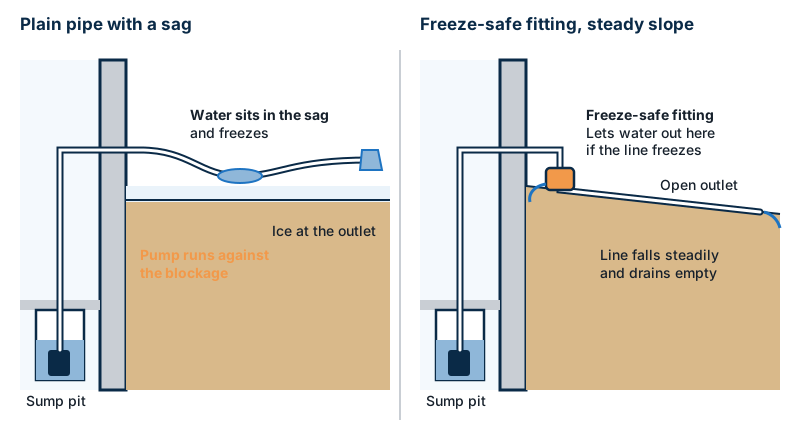
It is a backup, not a fix for a badly run line. Water released at the fitting ends up near the foundation, so the goal is still a line that drains and an outlet that stays open. The fitting is there for the days the line freezes anyway.
How to prevent a frozen discharge line
Most of these can be checked on a mild fall day.
- Walk the line. Follow the pipe from the wall to the outlet. Look for sags, joints that have pulled apart, and sections that have settled into the ground.
- Check the slope. The pipe should fall steadily away from the house. Raise or re-support any section that dips.
- Look at the outlet. It should empty onto ground that slopes away from the house, clear of leaves, soil and grass. Keep it out of spots where snow gets piled when you clear the drive or the walks. Michigan's environmental agency, EGLE, calls discharging to the ground where the water can soak in the preferred option, as long as it does not affect neighboring properties or cause erosion or ponding.
- Shorten or bury long surface runs. A long pipe lying on the lawn is the one most likely to freeze. A buried line that slopes to an outlet or an emitter in the yard stays out of the wind and carries water past the backfill, the loose soil around the foundation.
- Fit a freeze-safe fitting near the house if the line does not already have one.
- Test the pump. Pour water into the pit and watch it run and shut off. The fall sump pump checklist covers the full test.
Buried lines are the same kind of work we do for downspouts, and the buried gutter and downspout extensions page explains how they are laid and serviced. Where the yard itself holds water, the outlet needs somewhere to drain to, which is a yard drainage question.
What to do if your discharge line is frozen
First, check the pit. If the water is rising and the pump is running without lowering it, the line is probably blocked.
- If the line has a freeze-safe fitting, confirm water is coming out of it. If it is, the pump is doing its job while the rest of the line thaws.
- If there is no fitting, the water needs a temporary way out. Where the line has a coupling you can open outside, a length of hose from there to open ground away from the house can carry the water until the line thaws.
- Do not use an open flame or a torch on the pipe, especially a plastic one. The American Red Cross guidance on frozen pipes is explicit: "Do not use a blowtorch, kerosene or propane heater, charcoal stove, or other open flame device."
- Keep snow cleared from the outlet so meltwater can drain when the weather turns.
If the pump has been running against a blockage for a long time, have it checked once the line is open. A pump that ran hot may not start next time.
Saline: open ground and settled grade
Saline shows how the ground around a house changes the answer. The Saline service-area page covers the two things that make discharge lines matter there. Homes that back onto fields or open ground can take on runoff from well beyond their own lot, and pumps run hard in a wet spring. In newer subdivisions, the soil backfilled around the foundation keeps settling for years, so a slope that ran away from the house can end up running toward it. A discharge that empties onto that ground sends water back toward the wall, and a pipe laid on settling soil develops the sags that freeze.
How we install discharge lines
When we install or replace a sump pump, we run the discharge outside and away from the house through a freeze-safe fitting, so the line does not crack in winter. The basin sits at the low point of the basement in a bed of stone, and the pump is sized to the water the house actually takes on. If the pump is fine and the problem is only the line or the outlet, we say so and fix that.
Discharge line questions
Can I connect my sump pump to the storm sewer?
Only with permission. EGLE's guidance for Michigan residents says a storm sewer connection needs permission from whoever owns or runs that sewer, such as the city, the county road commission or the county drain commissioner. It also advises against sending sump water straight into lakes, streams or wetlands.
Can the discharge run onto the sidewalk or the street?
Check your city's rules first. Some Michigan cities treat it as a nuisance. East Lansing's guidance, for example, notes that sump water running across sidewalks or streets can cause icing in freezing weather and makes the property owner responsible for redirecting it.
Does a buried discharge line have to go below the frost line?
What matters most is that the line drains empty after every cycle. Water that does not sit in the pipe cannot freeze in it. A buried line laid with a steady fall to an open outlet stays out of the wind and the snow piles.
Will a frozen discharge line damage the pump?
It can. A pump running against a blocked line keeps working without moving water. Once the line is open, test the pump and have it checked if it ran for a long time.
Get your free sump pump inspection
If your discharge line froze last winter, runs across the lawn, or you are not sure where it ends, book a free inspection before the ground freezes. Call 248-635-3767 or request a visit online. We will test the pump, walk the discharge line and the ground around the house, and give you a written quote if anything needs work.
Sources
- Michigan Department of Environment, Great Lakes, and Energy (EGLE), Residential Sump Pump Discharges: Guidance for Michigan Residents (January 2022).
- American Red Cross, Frozen Pipes: no blowtorch or other open flame when thawing pipes.
- City of East Lansing, Roof and Sump Pump Drainage and Discharge.
Want someone to look at yours?
Free inspection, written quote, no obligation. Call 248-635-3767 or request a visit online.
- 4.9 on Google (46 reviews)
- Licensed MI builder #262400278
- Free inspection, written price first
- Free 6-month check-up after every job
- Based in Farmington Hills