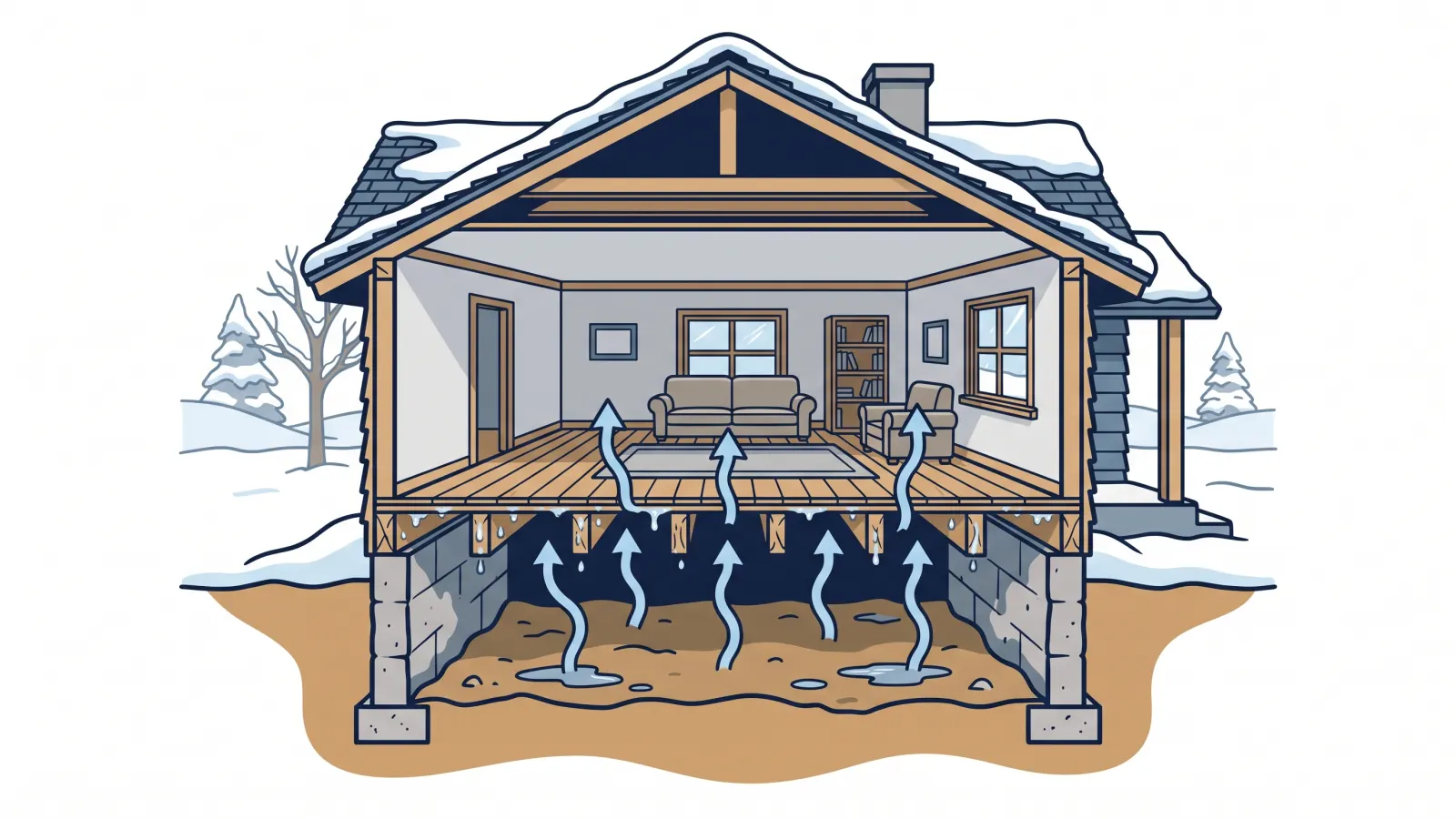
Cold floors and a damp smell over a crawl space usually have the same cause: the crawl space is open to the cold outside air and to the wet soil under it, and the house pulls that air up into the rooms above. In winter, warm air rising and leaving through the top of the house draws cold, damp air in at the bottom. The fix is to stop the water first, then seal the crawl space off from the soil and the outside so it becomes part of the house.
In short: a vented crawl space with a dirt floor lets cold outside air and ground moisture sit right under your floors, and the house draws that air upward in winter. Fix any water getting in, repair wet or rotted wood, then close the vents, cover the soil and walls with a sealed moisture barrier and insulate the walls. The US Department of Energy's Building America guidance describes this as making the crawl space part of the conditioned space of the home.
Written and reviewed by Swift Dry Construction, Michigan licensed residential builder #262400278, based in Farmington Hills.
What is going on in your crawl space
A crawl space is the short space between the ground and the first floor. Many have a bare dirt floor, block or poured walls, and vents to the outside. That was standard practice for decades. The idea was that outside air would dry the space out.
In a Michigan house it tends to work the other way. In summer, the vents let humid outdoor air in, and it condenses on the cooler surfaces underneath: pipes, ducts, the underside of the floor. The Department of Energy's Building America Solution Center notes that rather than drying a crawl space, vents "can actually encourage condensation" by letting warm, humid air in to condense on cooler floor joists. In winter, the same vents let cold air in, so the floor above sits over what is close to an outdoor space. And all year the dirt floor gives off moisture from the soil below, especially on wet ground or clay, which holds water and drains slowly.
The result is a space that is damp in one season and cold in the other, right under the rooms you live in.
Why the floors are cold in winter
The floor over a crawl space has only the floor structure between you and the air underneath. If that air is close to the outside temperature, the floor is cold. Common reasons:
- Open vents. Cold air moves straight in, and wind can push it through.
- Fallen or wet insulation. Batts stapled between the joists can sag or fall out over the years, and wet insulation does very little.
- Gaps around the rim. The band where the house framing sits on the foundation walls often has gaps that let outside air in.
- No insulation on the walls. An open crawl space loses heat through its walls and vents faster than a sealed one.
Pipes in a cold crawl space can also freeze in a hard winter. The American Red Cross lists water supply pipes in unheated areas such as crawl spaces among the pipes that freeze most often, which is a separate reason to look at it before the cold sets in.
How air and moisture rise into the house
The mechanism has a name: the stack effect. Warm air in the house rises and leaks out through the upper floors and the attic. That air has to be replaced, so the house draws air in at the bottom. In a house over a crawl space, some of that replacement air comes up from the crawl space, through gaps around pipes, ducts, wiring and the floor itself.
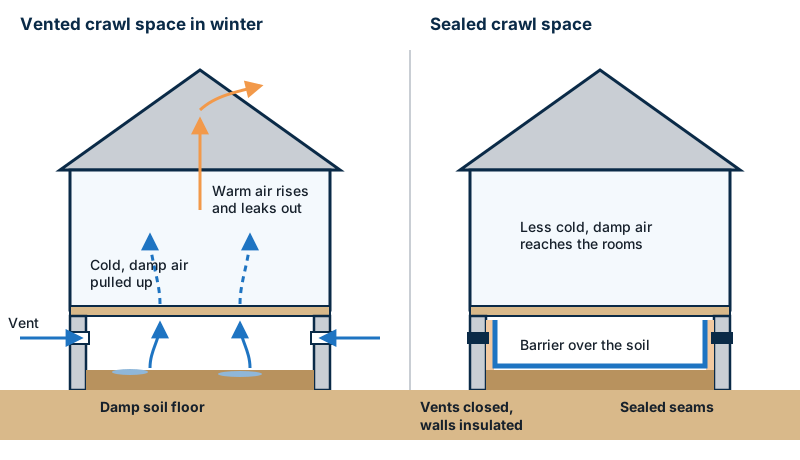
So whatever is in the crawl space air ends up upstairs: the damp, the cold and the musty smell. That is why a crawl space problem often shows up as damp or musty odours in the house, not in the crawl space itself.
Signs your crawl space has a moisture problem
You can check some of these from the access hatch with a flashlight. Do not crawl in if there is standing water near wiring or if you are not comfortable in a tight space.
- Damp or musty odours coming up into the house
- Standing water, wet soil, or condensation on pipes and ducts
- Insulation hanging down, fallen onto the floor, or wet
- Dark staining or mold on the joists or subfloor
- Floors above that feel soft, sag, or bounce more than they used to
- Cold floors in winter in the rooms over the crawl space
Soft or sagging floors matter most. They can mean the wood under the house has been wet long enough to rot, and that has to be repaired before anything is sealed. Sealing over structural damage just hides it.
Fix the water first, then seal
The order of work matters more than any product. If water is getting into the crawl space, no barrier will hold it back on its own.
- Find where the water comes from. Water in a crawl space usually starts as a drainage problem outside: downspouts emptying at the wall, ground sloping toward the house, or a yard that holds water. Those are fixed outside, and our yard drainage page covers how.
- Clear out and repair. Wet soil, failed insulation and debris come out. Rotted joists, sill plate or support posts are repaired, which is covered on our foundation repair page.
- Deal with water that still gets in. Depending on the source, that can be perimeter drainage inside the crawl space, or a sump to move groundwater out.
- Seal the space. Only then does the moisture barrier go down.
Crawl space encapsulation: what it changes
A vapor barrier is plastic laid over a dirt floor to slow the moisture coming up out of the ground. It helps. Full encapsulation goes further. It uses a heavier moisture barrier across the floor and up the walls, seals the seams, piers and penetrations, insulates the walls and closes the vents. The crawl space then stops being an outdoor space under the house and becomes part of the sealed shell.
That is the step that deals with the cold floors and the damp air. Building America's guidance on converting a vented crawl space to an unvented one says sealing off the vents, insulating the walls and covering the ground with a vapor barrier sealed to the walls "helps to reduce potential moisture problems by keeping out humid outside air and moisture vapor from the ground." Its guide to unvented, insulated crawl spaces adds that insulated crawl spaces "can keep floors warmer" and help protect plumbing pipes from freezing in cold climates.
The crawl space is no longer open to outside air in winter or humid air in summer, and it is cut off from the damp soil under it.
A closed crawl space is also allowed under the building code, with conditions. The same Building America guide notes that a sealed crawl space supplied with conditioned air meets the requirements of section R408.3 of the International Residential Code (2009 edition) for unvented crawl spaces, and adds that "local codes might have different requirements." The crawl space encapsulation service page walks through how we do it, step by step.
| Part of the job | Vapor barrier only | Full encapsulation |
|---|---|---|
| Ground cover | Plastic over the dirt floor | Heavier moisture barrier over the floor and up the walls |
| Seams, piers and penetrations | Not necessarily sealed | Sealed |
| Vents | Can stay open | Closed |
| Walls | Not insulated by the barrier | Insulated |
| Cold outside air under the floor | Still gets in through open vents | Kept out |
Crawl space dehumidification: do you need a dehumidifier?
Sometimes. A properly sealed crawl space with the water source controlled usually holds a reasonable humidity on its own. A hygrometer placed in the crawl space tells you: the US EPA advises keeping indoor humidity below 60 percent, ideally between 30 and 50 percent. If it still runs humid after encapsulation, or the house has a history of moisture problems, a dedicated dehumidifier can be worth adding. We would rather seal it correctly first and see where the humidity settles.
Older Ann Arbor houses and additions
Some older Ann Arbor houses have crawl spaces under additions or rear sections, joined to a full basement under the original house. The Ann Arbor service-area page notes these are worth checking at the same time as the basement, because a damp crawl space feeds moisture into the rooms above it. When the cold floor is in the back room or the addition, that is often where to look.
Crawl space questions
Should crawl space vents be open or closed in winter?
In a vented crawl space, open vents let cold air in under the floor all winter. Closing them on their own is not the full answer, because the soil still gives off moisture. Closing the vents is part of sealing the whole space: vents closed, soil and walls covered and sealed, walls insulated, and the space supplied with conditioned air or exhausted, as the code requires for an unvented crawl space.
Is a vapor barrier the same as encapsulation?
No. A vapor barrier is plastic laid over the dirt. Encapsulation seals that barrier to the walls and piers, closes the vents and insulates the walls, so the crawl space becomes part of the house.
Why are my floors cold only over the crawl space?
Because those rooms sit over air that is close to the outside temperature. Rooms over a heated basement do not. Fallen insulation, open vents and gaps at the rim make the difference larger.
Can I seal a crawl space that gets water in it?
Not until the water is dealt with. A barrier laid over wet ground traps the problem underneath. Fix the drainage outside, then any water that still gets in, then seal.
Get your free crawl space inspection
If the floors over your crawl space are cold, you smell damp in those rooms, or you have seen water or fallen insulation from the hatch, book a free inspection. Call 248-635-3767 or request a visit online. We will look at the crawl space, the wood and the ground around the house, tell you where the moisture is coming from, and give you a written quote with the scope and the order of work.
Sources
- US Department of Energy, Building America Solution Center, Unvented, Insulated Crawlspaces: vents can encourage condensation on floor joists; insulated crawlspaces can keep floors warmer and help protect pipes from freezing in cold climates.
- US Department of Energy, Building America Solution Center, Vented to Unvented Crawl Space: sealing vents, insulating walls and a sealed ground vapor barrier keep out humid outside air and ground moisture; the crawl space becomes part of the conditioned space.
- American Red Cross, Frozen Pipes: pipes in unheated crawl spaces freeze most often.
- US Environmental Protection Agency, A Brief Guide to Mold, Moisture and Your Home: indoor humidity below 60 percent, ideally 30 to 50.
Want someone to look at yours?
Free inspection, written quote, no obligation. Call 248-635-3767 or request a visit online.
- 4.9 on Google (46 reviews)
- Licensed MI builder #262400278
- Free inspection, written price first
- Free 6-month check-up after every job
- Based in Farmington Hills