
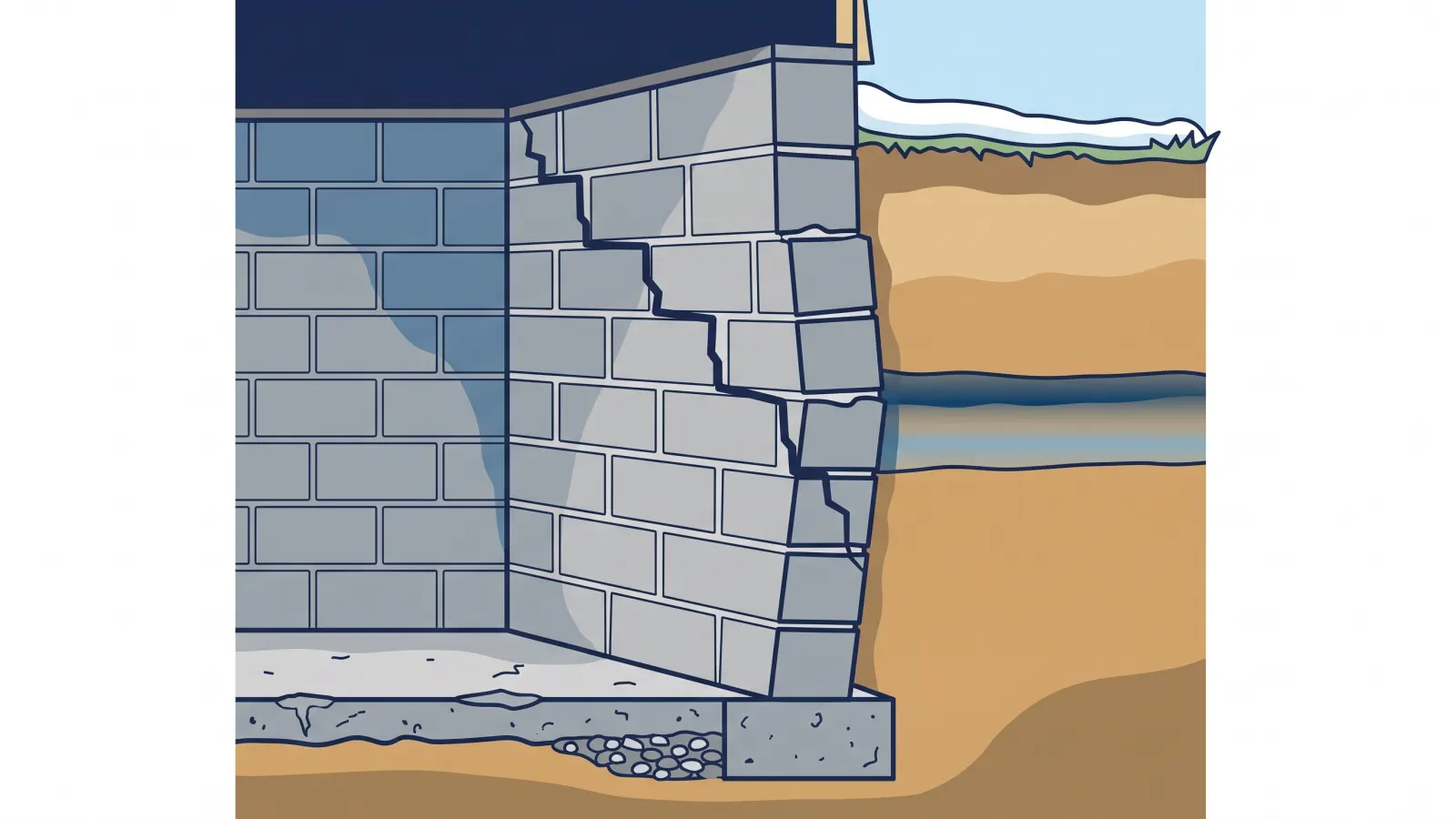
A stair-step crack on a basement wall built from block means part of the wall has moved. The crack follows the mortar joints because mortar is weaker than the block, so it climbs or drops one course at a time. It usually comes from one of two things: part of the foundation settling, or soil outside pushing on the wall. A thin stair-step crack that has not changed in years is less urgent than one that is widening, has blocks out of line, or sits near a bowing section of wall. Either way it is worth an inspection, because filler alone does not stop a wall that is still moving.
In short: a stair-step crack follows the mortar joints of a block wall and means that part of the wall has moved. Settling usually shows as a crack wider at one end that runs toward a corner. Soil pressure usually shows with a horizontal crack or a bow in the middle of the wall. Mark and photograph the crack this fall, check it again after the spring thaw, and get it inspected if it grows, the blocks shift or the wall bows.
Written and reviewed by Swift Dry Construction, Michigan licensed residential builder #262400278, based in Farmington Hills.
What is a stair-step crack?
Block walls are built from concrete blocks laid in rows, called courses, with mortar between them. Each block overlaps the joint below it. When the wall is stressed, the crack takes the easiest path, through the mortar, so it zig-zags across and down through the joints like a staircase.
In a poured concrete wall, cracks run straight through the concrete instead, usually vertically or at a slight angle. That is why a stair-step pattern is almost always a block or brick wall problem.
What causes stair-step cracks
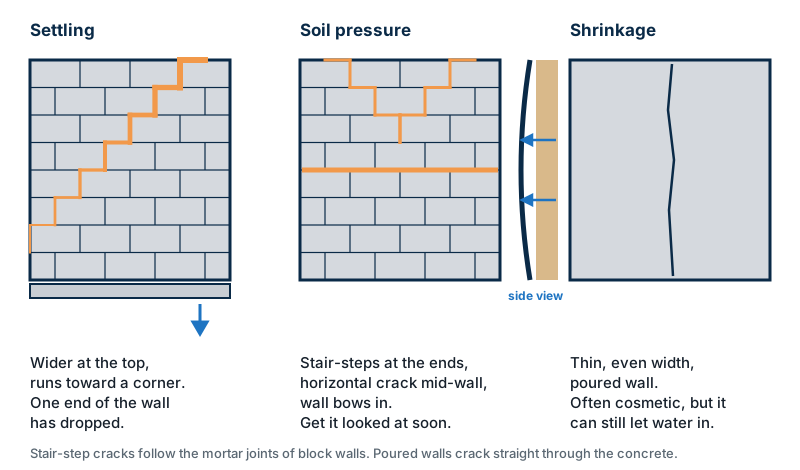
Settling. If the soil under one part of the footing compacts, washes out or was never compacted well, that part of the wall drops a little. The wall bends over the low spot and cracks through the mortar. A settling crack often runs toward a corner and is wider at one end than the other. Signs upstairs can go with it: doors that stick, and diagonal cracks out from door and window corners.
Soil pressure. Clay soil is common across Metro Detroit. It swells when it is wet and shrinks when it dries, so it pushes and releases against the wall through the year. Virginia's state geology office describes these expansive soils as soils "that exhibit changes in volume with changing moisture content", and lists jammed doors and windows and ruptured foundations among the damage they cause. Water that freezes in the soil adds pressure every winter. Michigan's building rules require exterior footings to extend 42 inches below grade, so the footing sits deep in the ground. The upper part of the wall is closer to the surface, and the soil against it freezes and thaws each winter. On a block wall, that push shows up as stair-step cracks near the ends of the wall, often together with a horizontal crack along the middle where the wall bends in.
Water next to the wall. Roof water dumped at the foundation, or ground that slopes toward the house, keeps the soil against the wall saturated. Wet clay pushes harder and can soften the soil under the footing, so water feeds both of the causes above. The same Virginia page names downspouts and rerouted drainage among the local conditions that can increase shrink and swell. The Department of Energy's Building America guidance on grading around a foundation calls for sloping soil away from the house "at least 0.5 inch per foot for 10 feet".
How to read your crack
You cannot always tell the cause by eye, but these clues narrow it down:
- Wider at the top than the bottom, or the reverse: one end of the wall has moved more than the other, which points to settling.
- A horizontal crack joining the stair-step, or the middle of the wall bowing in: soil pressure.
- Blocks that have shifted so the faces no longer line up across the crack: the wall has moved, not only cracked.
- Water, staining or efflorescence along the crack. Efflorescence is the white chalky residue that water leaves on masonry. It means the crack is carrying water, whatever caused it.
| Pattern | Usual cause | What to check next |
|---|---|---|
| Stair-step, wider at one end, runs toward a corner | Settling under part of the wall | Doors that stick, cracks at door and window corners upstairs |
| Stair-step near the wall ends plus a horizontal crack in the middle | Soil pushing the wall in | Bow along the wall with a straight edge or string |
| Stair-step with blocks out of line across it | The wall has moved, not only cracked | Get it inspected before winter |
| Thin vertical crack, even width, in a poured wall | Usually shrinkage | Water coming through after rain |
What to measure this fall
A pencil, a tape measure and a long straight edge give you a useful record before winter.
- Mark both ends of the crack with a pencil line and the date.
- Photograph it with a tape measure beside it for scale, from the same spot each time.
- Check the wall for bow. Hold a long straight edge or a tight string against the wall, top to bottom and end to end. On a wall that bows into the room it touches the high point in the middle, and a gap opens at the ends.
- Check the blocks line up across the crack.
- Go outside on the same wall. Look for a downspout at the wall, ground sloping toward the house, or a low spot that holds water.
Check again after the spring thaw. A crack that has grown past your marks, or a wall that has moved, has gone from something to watch to something to fix.
The earlier post on foundation cracks and when to worry covers the other crack patterns and what frost does to a cracked wall.
When a stair-step crack needs repair
Have it looked at if the crack is getting longer or wider, if blocks have shifted, if the wall bows, if there is a horizontal crack on the same wall, or if water comes through it. A thin stair-step crack that has not moved in years, with a straight wall and no water, is lower on the list. It is still worth having it on record.
Filling a stair-step crack with mortar or sealant on its own rarely solves anything. If the wall is still moving, the filler cracks again. How the wall gets fixed depends on the cause: a settled section is dealt with at the footing and the soil under it, and a wall pushed in by soil is stabilized before anything is sealed. Taking water away from the wall outside, with downspouts and grade, often takes pressure off at the same time.
Because the basement wall is the foundation wall, a leaking crack is both a structural and a water question. We quote the structural repair and the waterproofing together. Read more on our foundation repair page, or our basement waterproofing page if water is the main symptom.
Older block foundations in Detroit
Many Detroit houses are older homes on block or brick foundations that have been through decades of Michigan winters. The Detroit service-area page describes what that looks like: worn mortar joints, old drain tile around the footing that has silted up, and grade that has settled back toward the house. On block walls it shows up as stair-step cracks, a horizontal crack along the middle of a wall, or a wall that has started to lean in.
Stair-step crack questions
Are stair-step cracks normal in an older block basement?
Old or not, a stair-step crack is a record of movement, so treat it as something to track rather than ignore. A thin crack that has not changed in years, in a straight wall with no water, is low on the list. One that grows, lets water in or comes with a bow needs a look.
Can I just fill a stair-step crack with mortar?
You can, but filler does not stop movement. If the wall is still moving, the filled crack opens again. Find out whether it is settling or soil pressure first.
Do stair-step cracks get worse in winter?
They can. Water that freezes in the soil adds pressure in winter, and the thaw leaves the clay against the wall saturated. That is why marking the crack in fall and checking it after the thaw gives you a useful comparison.
Does a stair-step crack mean the foundation is failing?
Not by itself. It means part of the wall has moved. Whether it needs repair depends on whether it is still moving, whether the wall bows and whether water comes through.
Get your free foundation inspection
If you have a stair-step crack that has grown, blocks out of line, a bowing wall or water coming through a crack, book a free inspection before the ground freezes. Call 248-635-3767 or request a visit online. We will tell you what the crack means, whether it needs work now or can be watched, and give you a written quote if it needs repair.
Sources
- Virginia Department of Energy, Geology and Mineral Resources, Expansive Soils: soils that change volume with moisture; downspouts and drainage can increase shrink and swell; frost heave.
- Michigan Administrative Code R 408.30522, Minimum depth: exterior footings extend 42 inches below grade.
- US Department of Energy, Building America Solution Center, Final Grade Slopes Away from Foundation: slope soil away from the house at least 0.5 inch per foot for 10 feet.
Want someone to look at yours?
Free inspection, written quote, no obligation. Call 248-635-3767 or request a visit online.
- 4.9 on Google (46 reviews)
- Licensed MI builder #262400278
- Free inspection, written price first
- Free 6-month check-up after every job
- Based in Farmington Hills