
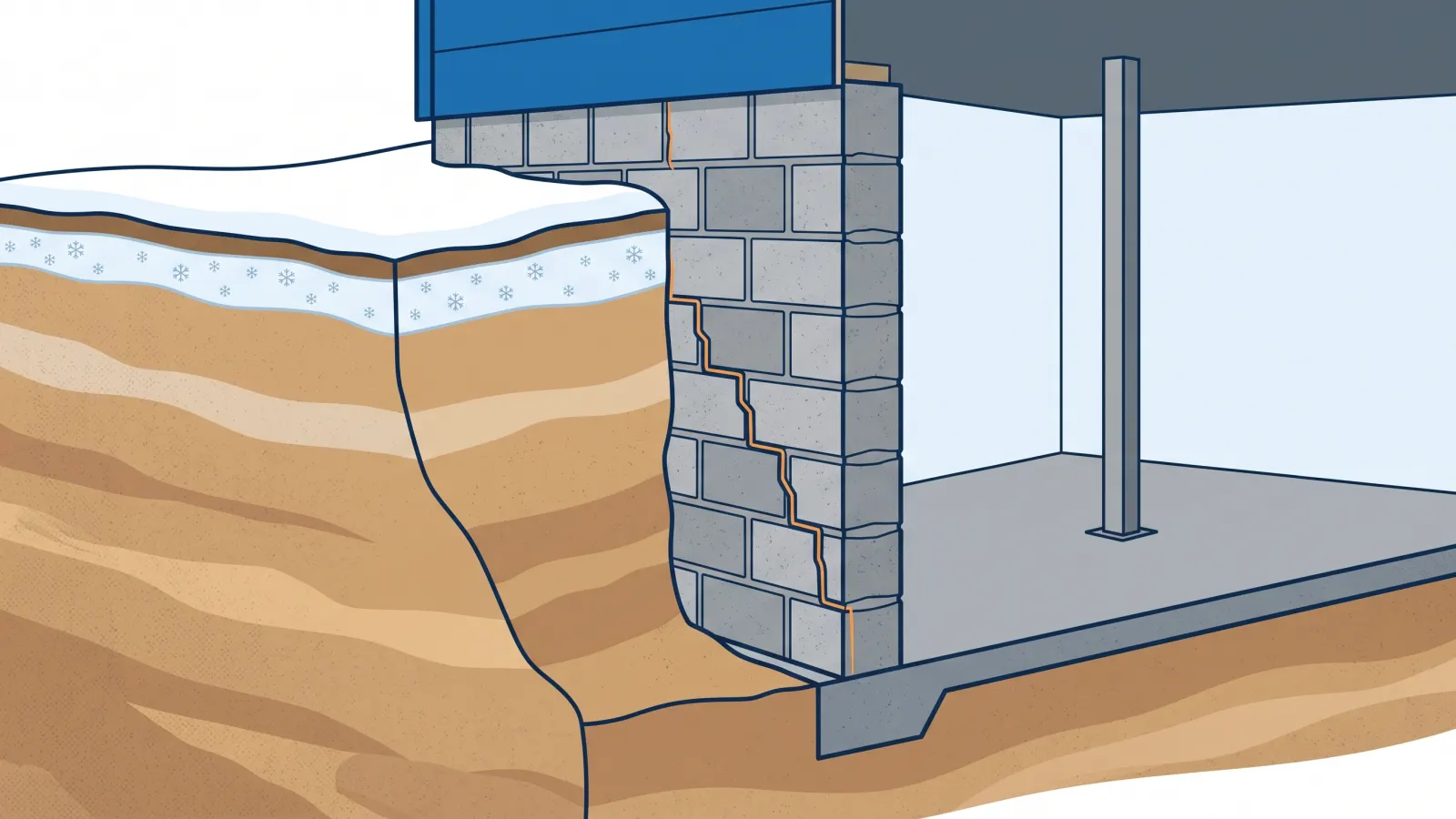
Worry about a foundation crack when it is horizontal, when it runs in a stair-step pattern through a block wall, when it is wider at one end than the other, when the wall on either side has moved out of line, or when it is growing. A thin vertical crack in a poured concrete wall is common and often cosmetic, though it can still let water through. Fall is the time to sort out which one you have, because a Michigan winter adds frost and freeze-thaw to whatever the soil was already doing to the wall.
When should you worry about a foundation crack?
Many basements have some cracks. The question is what the crack is telling you. These are the ones worth having looked at:
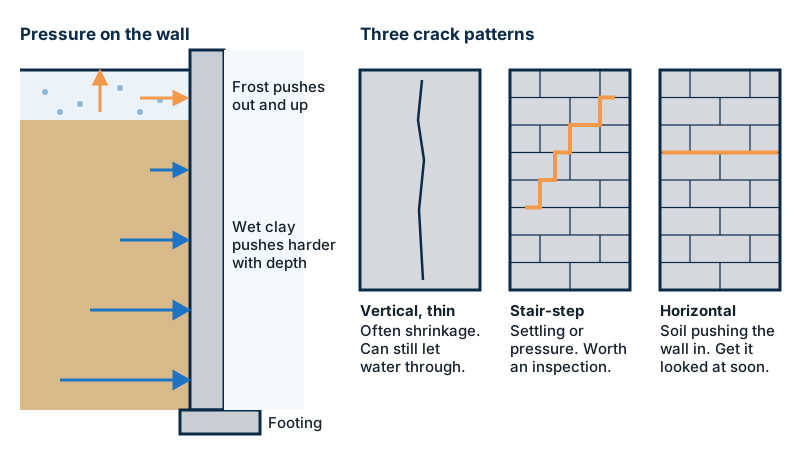
- Horizontal cracks partway up a block or poured wall. These usually mean the soil outside is pushing the wall in.
- Stair-step cracks that follow the mortar joints in a block wall. These can come from settling or from pressure on the wall.
- Cracks wider at one end, which point to one part of the foundation moving more than another.
- A wall that bows, leans or has shifted at a crack, so the two sides no longer line up.
- Cracks that are getting longer or wider over months.
- Cracks with other signs upstairs: doors and windows that start sticking, or new drywall cracks above the same wall.
These are usually lower on the list:
- A thin vertical or slightly diagonal crack in a poured wall that has not changed in years.
- Hairline cracks in the floor slab with no height difference across them.
"Lower on the list" does not mean ignore it. A thin crack can still carry water every time the soil outside is wet. As we put it on our basement waterproofing page: if water is coming through a crack, the crack is the job.
Why does my foundation crack?
Concrete shrinks as it cures. That shrinkage is the usual cause of the thin vertical cracks in poured walls, and it often shows up in the first years after the house is built.
The cracks that need attention usually come from outside the wall. Clay soil is common across Metro Detroit. Clay swells when it is wet and shrinks when it dries, so the pressure on a basement wall changes with the seasons. Wet clay pushes harder, and the push grows with depth. Over decades, that is what bows block walls and opens horizontal cracks.
Water makes it worse. When roof water from a downspout or a yard that slopes toward the house keeps the soil by the wall soaked, the wall carries more load than it needs to. Settling is the other common cause: if the soil under part of the footing compacts or washes out, that section drops, and the wall above cracks, often in a stair-step or with one end wider than the other.
Age plays a part too. Many houses in older suburbs sit on block walls from the postwar decades. Block holds up well, but after sixty or seventy winters the mortar joints are the weak points, and that is where stair-step cracks run.
What frost and freeze-thaw do to a cracked wall
In winter the top layer of soil freezes. Water expands as it freezes, so wet soil near the surface pushes outward and upward. That can press on the upper part of a basement wall and lift things resting on the ground, such as steps and walkways.
Freeze-thaw is the repeated version. Water gets into a crack, freezes and widens it a little, then thaws and soaks in deeper. A Michigan winter can do that many times. A crack that let in a little water in October can let in more by March.
The spring thaw then adds a lot of water to the soil at once. If the soil by the wall is already saturated and the drainage around the house is poor, the pressure on the wall is at its highest just when the crack is at its widest.
What to do this fall
A pencil, a phone camera and a straight edge are enough to get a useful picture. Before the ground freezes:
- Mark the ends of each crack with a pencil line and the date. If it grows past the mark, you will know.
- Photograph each crack with a tape measure or a coin beside it for scale.
- Check whether the wall lines up. Hold a long straight edge or a string along the wall. A bow or a step at the crack matters more than the crack itself.
- Walk around the outside. Look for downspouts that empty at the wall and ground that slopes toward the house on the same side as the crack.
- Note any water. Damp edges, white chalky residue called efflorescence, or staining below a crack all mean water is getting through.
If the outside checks turn up a downspout or grading problem, fix that first. It is often the least expensive way to take pressure off the wall.
Crack repair and waterproofing, quoted together
A cracked wall and the water coming through it are usually the same problem. The basement wall is the foundation wall, so we look at the crack, the wall around it, the soil and the drainage outside before recommending anything. How a crack gets fixed depends on what caused it. A thin crack that only leaks is sealed through its full depth so water cannot follow it, and that is often a single-day repair. A bowing wall or a horizontal crack means the wall has to be stabilized before it is sealed, or the new seal cracks along with the wall. That is why we quote the structural repair and the waterproofing together.
Read more on our foundation repair page. In Livonia and other areas built out in the 1950s and 60s, many houses sit on block basements, and stair-step cracks and bowing walls are the typical weak points.
Get your free foundation inspection
If you have a horizontal crack, a bowing wall, or a crack that has grown since you last looked, book a free inspection before the ground freezes. Call 248-635-3767 or request a visit online. We will tell you what the crack means, whether it needs work now, and give you a written quote if it does.
Want someone to look at yours?
Free inspection, written quote, no obligation. Call 248-635-3767 or request a visit online.
- 4.9 on Google (46 reviews)
- Licensed MI builder #262400278
- Free inspection, written price first
- Free 6-month check-up after every job
- Based in Farmington Hills