
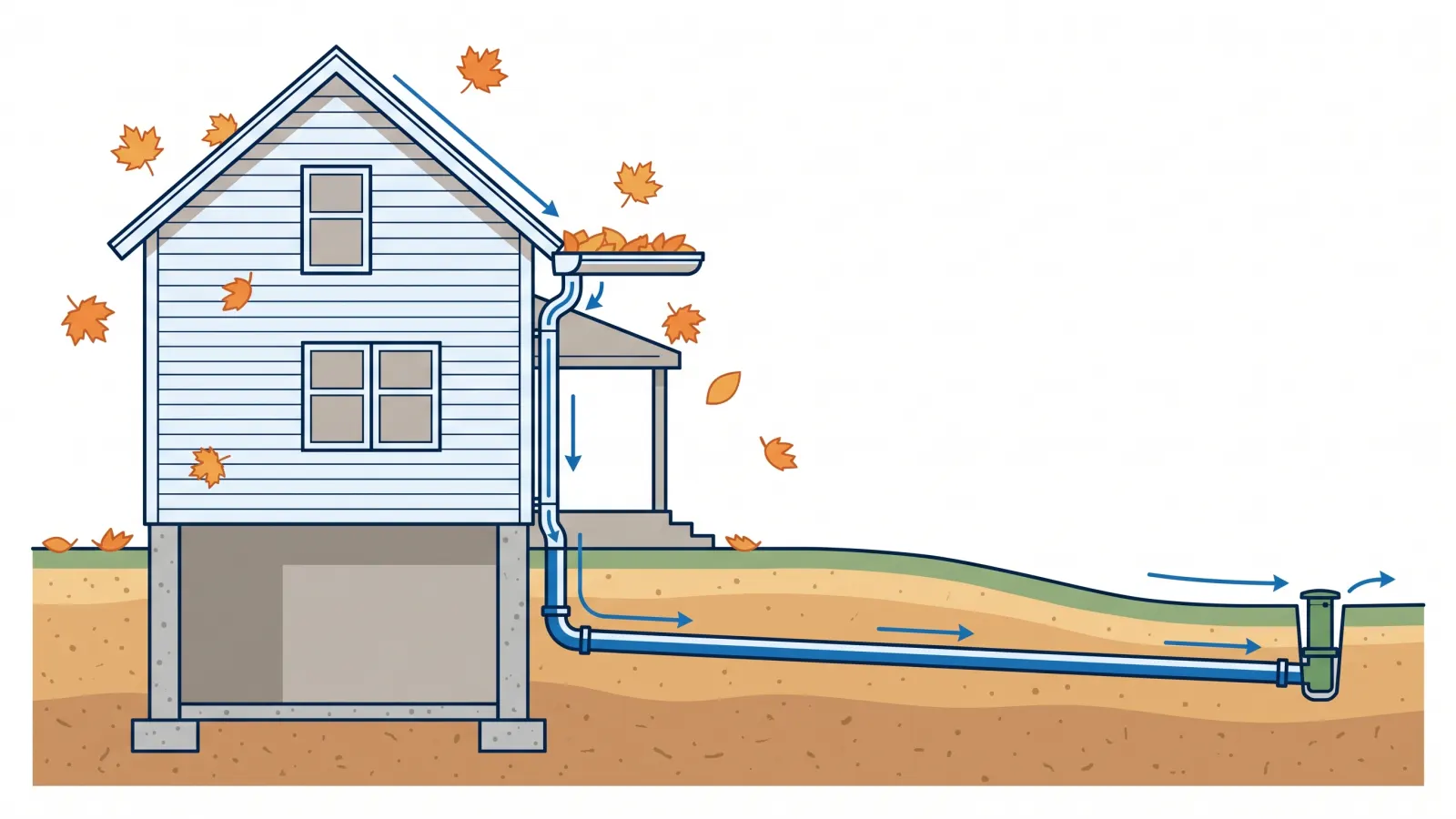
Before the ground freezes, clean the gutters once the leaves are down, make sure every downspout carries water well away from the foundation, and check that the ground slopes away from the house on every side. Roof water that lands beside the foundation is a common reason a basement takes on water, and it is often one of the less expensive things to fix. Once the ground is frozen, digging gets harder, so fall is the time to do it.
Why roof water ends up in the basement
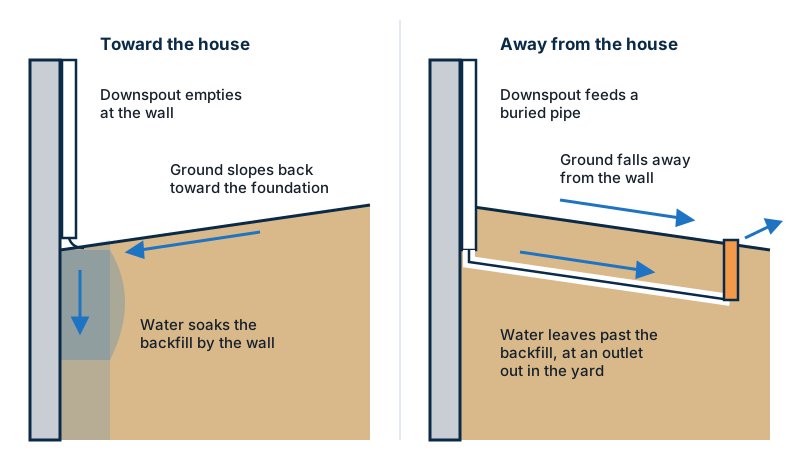
A roof collects a lot of water and sends all of it to a few downspouts. If a downspout empties at the base of the wall, all the water from that part of the roof soaks into the soil right beside the basement.
That soil is backfill: the loose soil put back around the foundation when the house was built. It takes water in easily, and on clay soil, which is common across Metro Detroit, the water has nowhere to go once it gets there. It sits against the wall and presses on it until it finds a crack or the joint where the wall meets the floor.
Water in one corner of the basement after a storm usually points to a downspout or grade problem outside that corner. Standing water almost never starts where it collects.
Clean the gutters after the leaves drop
Gutters full of leaves overflow. Water spills over the edge along the whole length of the roof and lands next to the foundation, so the downspouts never get the chance to carry it away.
Clean them once most of the leaves are down, not in early autumn when more are still to fall. While you are up there:
- Check each downspout is clear by running water into the gutter above it
- Look for gutter sections that sag and hold water, or have pulled away from the fascia
- Check the joints and end caps for drips
A gutter that holds water can freeze solid in winter, and then melting snow on the roof has nowhere to go but over the edge.
Where should downspouts empty?
Out past the backfill, onto ground that slopes away from the house, and not onto a neighbor's property. A short elbow at the bottom of the downspout, or a splash block, usually puts the water only a short way from the wall, which is often still inside the backfill.
There are two common ways to carry it further:
- An above-ground extension. A length of pipe on the surface. Inexpensive and easy to fit, but it gets knocked out of place, run over by mowers and lifted by snow shovels.
- A buried extension. A pipe run underground from the base of the downspout out into the yard, ending at an outlet where the water can spread out. Nothing to trip over, and it stays in place.
If you have a sump pump, the same rule applies to its discharge line. It should not empty next to the foundation either.
Check the grade around the house
Grade is the slope of the ground. It should fall away from the house on every side, so rain and snowmelt run away from the foundation instead of toward it.
Over the years, backfill settles. A strip of ground that sloped away when the house was new can end up sloping back toward the wall. Walk around the house after a rain and look for:
- Puddles or soft ground next to the foundation
- Flower beds or edging that trap water against the wall
- Patios, walks or driveways that tilt toward the house
- Downspouts that empty into a low spot
Where the ground has settled, building it back up with soil so it slopes away can take a lot of water off the basement wall. Do this before the ground freezes, and before snow piles up against the house.
When a buried downspout extension makes sense
A buried extension is worth considering when above-ground extensions keep getting moved or damaged, when the water needs to go further than a surface pipe can easily reach, or when a downspout sits beside a walkway or driveway. It is also a good fit for a sump pump discharge that currently empties near the house.
The details matter. The line has to fall all the way to the outlet so water does not sit in it, and the outlet has to be somewhere the water can spread out and soak in, away from the house. We cover how we do it on our buried gutter and downspout extensions page.
When the yard itself holds water
Sometimes the downspouts and grade are fine and the yard still holds water. That is more common on flat, heavy clay ground. In Warren and other flat parts of southern Macomb County, water can sit in yards and against foundations long after a storm.
When that is the case, the answer is usually a drainage fix in the yard: regrading a larger area, or French drain installation. A French drain is a gravel-filled trench with a perforated pipe that collects water and carries it somewhere it can drain. Putting a drain in the wrong place moves the puddle instead of removing it, so the first step is working out where the water comes from and where it can go. Our yard drainage page explains the options.
Before anyone digs
In Michigan, anyone digging is required to contact MISS DIG 811 first so buried utility lines are marked. That applies to a homeowner burying a downspout line as much as to a contractor. Call or file online a few working days before you plan to dig.
Book a free drainage inspection
If one corner of your basement gets wet after storms, or your yard holds water against the house, book a free inspection before the ground freezes. Call 248-635-3767 or request a visit online. We will look at the gutters, downspouts, grade and basement together and tell you the smallest fix that solves it, with a written quote.
Want someone to look at yours?
Free inspection, written quote, no obligation. Call 248-635-3767 or request a visit online.
- 4.9 on Google (46 reviews)
- Licensed MI builder #262400278
- Free inspection, written price first
- Free 6-month check-up after every job
- Based in Farmington Hills